

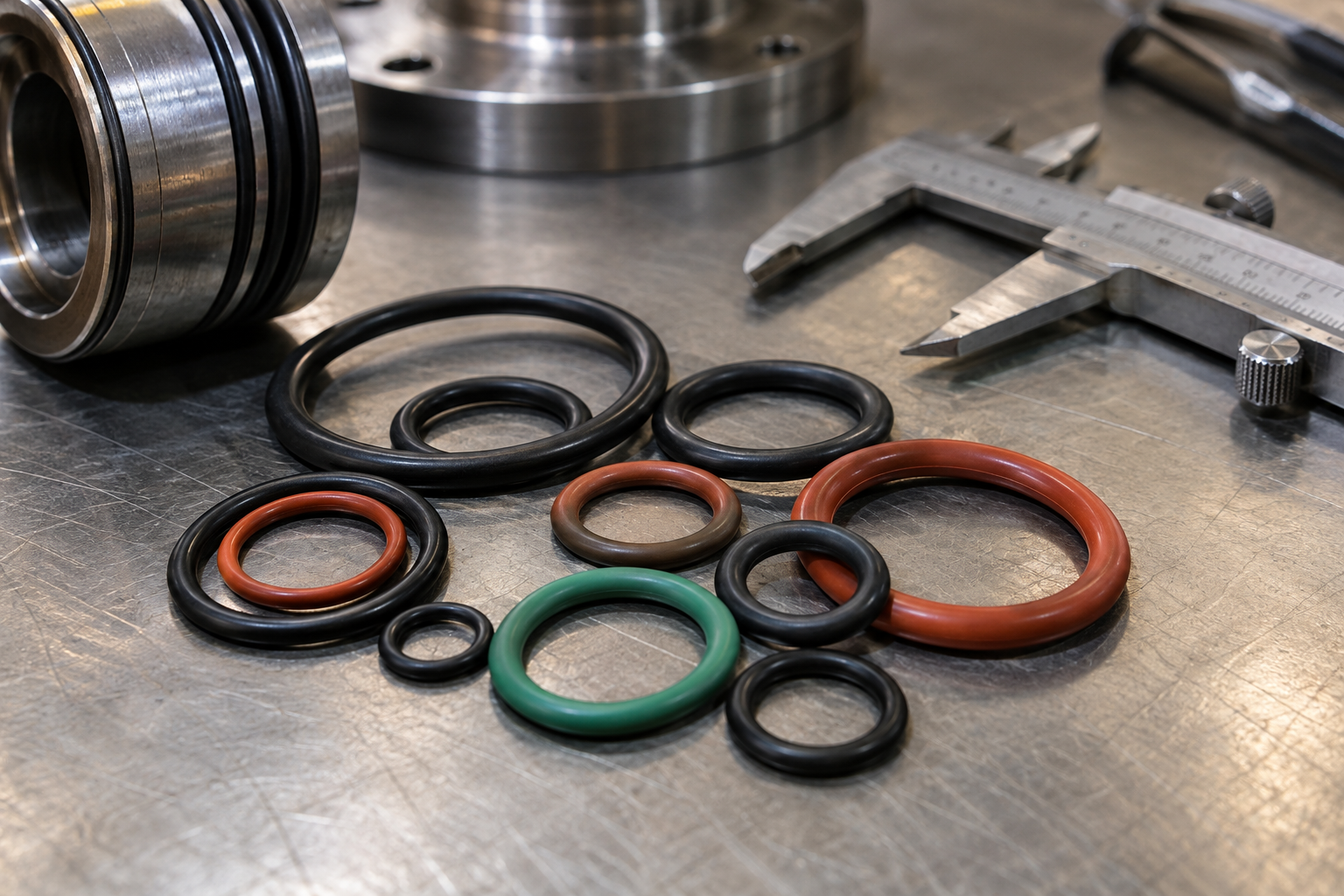

How to Choose the Right O-Ring Material and Size in Malaysia
Choosing the right O-Ring involves more than finding a seal that fits the available space. The O-Ring material, size and operating conditions all affect whether the seal is suitable for a particular industrial application.
For engineers, maintenance teams and industrial buyers in Malaysia, factors such as the fluid or media being sealed, operating temperature, pressure and whether the application is static or dynamic should be considered before selecting an O-Ring.
This guide explains how to choose an O-Ring based on material, size and application requirements, including how to compare common materials and determine the correct O-Ring dimensions.
What Should You Consider When Choosing an O-Ring?
The main factors to consider when choosing an O-Ring are its material, size, fluid or media compatibility, operating temperature, pressure and application conditions. These factors should be evaluated together because an O-Ring that fits dimensionally may still be unsuitable if its material or operating limits do not match the application.
Start by identifying what the O-Ring will seal and the conditions it will operate under. For example, the sealing material should be compatible with the fluid or chemical it will contact, while the O-Ring dimensions should match the required sealing arrangement. Temperature, pressure and whether the seal is used in a static or moving application can also influence the final selection.
Sunseal’s O-Ring range includes different materials, sizes, hardness levels and dimensional standards for different industrial requirements. Its product information also identifies operating media, temperature, system pressure and environmental conditions as factors to consider when selecting an O-Ring.
| Selection Factor | What to Check |
|---|---|
| Material | Whether the O-Ring material is suitable for the application |
| Size | Inside diameter (ID) and cross-section (CS) |
| Fluid / Media | Compatibility with the substance being sealed |
| Temperature | Expected operating temperature conditions |
| Pressure | Pressure conditions within the system |
| Application | Whether the seal is used in a static or dynamic application |
Once these operating requirements are understood, the next step is choosing an appropriate O-Ring material.
How Do You Choose the Right O-Ring Material?
The right O-Ring material should be selected based on the fluid or media being sealed, operating temperature, pressure, application conditions and the performance required from the seal. There is no single O-Ring material that is suitable for every industrial application.
Different elastomer materials have different resistance characteristics. A material that performs well with one fluid or operating environment may not be suitable for another. This is why material selection should begin with the actual operating conditions rather than choosing an O-Ring based only on price, colour or availability.
Sunseal offers O-Rings in materials including NBR (Nitrile), FKM (Viton), Silicone, AFLAS and FFKM, allowing different material options to be considered according to the application. Sunseal also identifies factors such as operating media, temperature, system pressure and environmental conditions as important considerations when selecting an O-Ring.
In practice, the material should be checked against the specific application requirements and relevant technical compatibility information before the final selection is made.
Common O-Ring Materials and Their Selection Considerations
| O-Ring Material | General Selection Consideration |
|---|---|
| NBR (Nitrile) | Commonly used for industrial sealing applications involving oils and lubricants, subject to the specific compound and operating conditions. |
| FKM (Viton) | Often considered where greater resistance to elevated temperatures, oils, fuels or certain chemicals is required. |
| Silicone | Often considered where flexibility across a broad temperature range is important, depending on the application. |
| AFLAS | Used in selected demanding applications where resistance to particular chemicals, heat and operating environments is required. |
| FFKM | A high-performance sealing material considered for demanding chemical and temperature environments where application requirements justify its use. |
Among these materials, NBR and FKM are two options that are often compared when selecting O-Rings for industrial applications. However, their performance characteristics and suitable operating conditions are different.
Nitrile vs Viton O-Rings: What Is the Difference?
Neither Nitrile (NBR) nor FKM/Viton is automatically the better O-Ring material. NBR is widely used for general industrial sealing involving oils and greases, while FKM is often considered when greater resistance to heat, fuels, oils and certain chemicals is required. The right choice depends on the media, temperature and operating conditions of the application.
NBR is a commonly used sealing material with good oil resistance and mechanical properties. This makes it suitable for many general industrial applications involving mineral-based oils and greases. However, its suitability still depends on the specific NBR compound and the substance being sealed.
FKM, commonly associated with the Viton trade name, is generally selected for more demanding temperature and chemical environments. It offers strong resistance to many oils, fuels and chemicals, but it is not universally compatible with every substance. The specific media and operating conditions should still be checked before selection.
| Selection Factor | NBR (Nitrile) | FKM / Viton |
|---|---|---|
| General Positioning | Common general-purpose industrial sealing material | Often selected for more demanding operating environments |
| Oils & Greases | Good resistance to many oils and greases | Strong resistance to many oils and lubricants |
| Fuels | Suitability depends on the fuel and compound | Generally offers broader fuel resistance |
| Heat | Moderate heat resistance | Generally provides higher heat resistance |
| Chemical Exposure | Compatibility must be checked against the specific media | Broader resistance to many chemicals, but not universal |
| Cost Consideration | Generally the more economical material | Typically a higher-performance material and may involve higher cost |
| When to Consider | General industrial applications where NBR meets the operating requirements | Applications requiring greater heat, fuel or chemical resistance |
So, Should You Choose NBR or FKM?
If the application involves general industrial oils or greases and NBR meets the required operating conditions, NBR may be an appropriate option. If the application involves higher temperatures, fuels or more demanding chemical exposure, FKM may be worth considering. In either case, material compatibility should be confirmed against the actual media and operating conditions rather than selecting solely by material name.
How Do You Determine the Correct O-Ring Size?
The correct O-Ring size is commonly identified using its inside diameter (ID) and cross-section (CS). The outside diameter (OD) can then be used as an additional reference or calculated from these dimensions. For replacement applications, the measured dimensions should also be checked against the original specification or an appropriate O-Ring size standard where possible.
Sunseal defines O-Ring dimensions using three measurements: inside diameter (ID), outside diameter (OD) and cross-section width (CS/W). However, an O-Ring size is typically expressed using its ID and CS. For example, an O-Ring may be specified as ID 20 × CS 2 mm.
The relationship between these dimensions can be expressed as:
OD = ID + (2 × CS)
For example, an O-Ring with an ID of 20 mm and a cross-section of 3 mm has a nominal outside diameter of:
20 + (2 × 3) = 26 mm
Knowing these dimensions helps narrow down the required size, but dimensional fit should not be considered separately from the seal design and application. Technical O-Ring references also account for factors such as tolerances, groove dimensions and whether the seal is used in a static or dynamic application.
How Do You Measure an O-Ring?
To measure an O-Ring, identify its inside diameter (ID) and cross-section (CS), then use the outside diameter (OD) as an additional dimensional check. Accurate measurements are particularly important when identifying a replacement O-Ring without a known part number or specification.
The inside diameter is the distance across the inner opening of the O-Ring, while the cross-section is the thickness of the ring itself. The outside diameter represents the overall diameter measured from one outer edge to the opposite outer edge.
For a replacement O-Ring, avoid relying on only one measurement. A used seal may have changed shape during service, so its measured dimensions may not perfectly represent its original nominal size. Where available, compare the measurements with the original equipment specification, part number or applicable O-Ring size standard before selecting the replacement.
| Measurement | What It Means | Example |
|---|---|---|
| ID | Inside diameter of the O-Ring | 20 mm |
| CS | Thickness / cross-section of the O-Ring | 3 mm |
| OD | Overall outside diameter | 26 mm |
| Formula | OD = ID + (2 × CS) | 20 + (2 × 3) = 26 mm |
What Are Standard O-Ring Sizes?
There is no single O-Ring size that is standard for every application. O-Rings are available in established dimensional series and standards, so the required size should be matched to the equipment, groove and applicable specification.
Sunseal states that its O-Ring range follows international dimensional standards including AS568B, DIN ISO 3601 and JIS, while custom dimensions are also available for requirements that fall outside standard sizes.
Standard size references are useful because they define nominal dimensions and tolerances rather than simply providing a list of diameters. When replacing an O-Ring, it is therefore better to identify the required ID, cross-section and applicable standard instead of choosing a seal simply because its outside diameter appears similar.
How Do Operating Conditions Affect O-Ring Selection?
Operating conditions affect O-Ring selection because the seal must remain suitable for the media, temperature, pressure, movement and environment it will experience during operation. An O-Ring that is suitable for one application may not perform the same way when these conditions change.
For this reason, material and size should not be selected independently from the actual operating environment. Before choosing an O-Ring, consider what substance it will contact, the expected temperature and pressure, whether the seal remains stationary or moves during operation, and any environmental exposure that could affect the sealing material.
Sunseal also identifies factors such as operating media, temperature, system pressure and environmental conditions as considerations when selecting O-Rings. Technical O-Ring guidance similarly evaluates material compatibility and seal design according to the conditions of the application rather than relying on material type alone.
Fluid and Chemical Compatibility
The O-Ring material should be compatible with the fluid, gas or chemical it will contact. Exposure to unsuitable media can affect the properties of the elastomer and reduce its ability to maintain an effective seal.
Compatibility should therefore be checked against the specific media and O-Ring compound, rather than assuming that a material is resistant to every type of oil, fuel or chemical. This is particularly important when selecting between materials such as NBR, FKM, Silicone, AFLAS and FFKM.
Operating Temperature
The expected operating temperature should be considered when selecting an O-Ring material because elastomers respond differently to heat and cold. Temperatures outside a material’s suitable operating range can affect its flexibility, sealing behaviour and service performance.
Instead of choosing an O-Ring based on a single general temperature figure, the temperature requirement should be checked against the specific material or compound being considered and the conditions of the application.
System Pressure
System pressure can influence both O-Ring material selection and the overall sealing design. As pressure increases, factors such as the seal material, hardness, dimensional tolerances, groove design and extrusion clearance can become increasingly important.
This means pressure suitability should not be determined by O-Ring size alone. For higher-pressure applications, the complete sealing arrangement may need to be evaluated, including whether additional sealing support such as a back-up ring is appropriate for the design.
Static vs Dynamic Applications
Whether an O-Ring is used in a static or dynamic application can affect the selection requirements. In a static application, the sealing surfaces generally remain stationary relative to each other. In a dynamic application, the O-Ring may be exposed to reciprocating, rotating or other movement.
Dynamic applications can introduce additional considerations such as friction, wear, lubrication and surface conditions. Therefore, an O-Ring that is suitable for a static seal should not automatically be assumed to be suitable for a moving application without checking the relevant design requirements.
Environmental Exposure
External environmental conditions should also be considered when the O-Ring is exposed to factors beyond the media inside the system. Depending on the application, this may include outdoor conditions, ozone, weathering or other environmental exposure.
These conditions can influence which elastomer is appropriate, so both the internal media and the external operating environment should be considered before the final material is selected.
O-Ring Operating Conditions Checklist
| Operating Condition | Question to Ask Before Selection |
|---|---|
| Media | What liquid, gas or chemical will contact the O-Ring? |
| Temperature | What temperatures will the seal experience during operation? |
| Pressure | What system pressure and sealing design will the O-Ring operate under? |
| Motion | Is the application static, reciprocating or rotating? |
| Environment | Will the seal face outdoor, ozone, weather or other external exposure? |
Common O-Ring Selection Mistakes to Avoid
Common O-Ring selection mistakes include choosing by size alone, ignoring material compatibility, measuring only the outside diameter, relying entirely on a used O-Ring for replacement dimensions, and assuming that a larger or thicker O-Ring will create a better seal. Avoiding these mistakes can help narrow down a more suitable O-Ring before the final specification is confirmed.
O-Ring selection involves several connected factors. The correct dimensions are important, but they need to work together with the material, operating media, temperature, pressure and sealing design. A seal that appears to fit physically is not necessarily suitable for the application.
Choosing an O-Ring by Size Alone
A matching size does not automatically mean that an O-Ring is suitable for the application. Two O-Rings can have the same dimensions but be made from different elastomers with different compatibility and performance characteristics.
After identifying the required size, check the material against the media and operating conditions before making the final selection.
Ignoring Fluid or Chemical Compatibility
Do not select an O-Ring material without considering what liquid, gas or chemical it will contact. Different elastomers respond differently to different media, and compatibility can also vary between specific compounds.
Instead of assuming that a commonly used material such as NBR or FKM will work in every application, check its compatibility with the actual operating media.
Measuring Only the Outside Diameter
Outside diameter alone is not enough to properly identify an O-Ring size. As explained earlier, O-Rings are commonly identified using their inside diameter (ID) and cross-section (CS), with OD serving as an additional dimensional reference.
When identifying a replacement, measure the ID and cross-section and compare the dimensions with the relevant specification or standard where possible.
Relying Only on a Used O-Ring for Replacement Size
A used O-Ring may no longer represent its original nominal dimensions. During service, a seal can experience wear, compression, swelling, stretching or other dimensional changes depending on its application and operating environment.
Measurements from the old O-Ring can still provide a useful reference, but they should be checked against the equipment specification, part number, groove dimensions or applicable size standard whenever that information is available.
Assuming a Larger or Thicker O-Ring Will Seal Better
A larger or thicker O-Ring does not automatically create a better seal. O-Ring performance depends on how the seal fits within the designed groove and how it behaves under the operating conditions.
Installing an incorrectly sized O-Ring can change the intended compression and fit. The replacement should therefore follow the required dimensions and sealing design rather than simply increasing the O-Ring size.
Choosing O-Ring Material by Colour Alone
O-Ring colour should not be used as the only method for identifying its material. Colour may sometimes be associated with particular compounds or manufacturers, but it is not a universal material identification system.
Where material identification matters, confirm the material specification, part information or supplier documentation instead of relying only on visual appearance.
A better O-Ring selection process is to confirm the application first, then check the material, size and operating conditions together. If the existing O-Ring cannot be identified confidently, providing the supplier with the available dimensions and application information can help narrow down the appropriate option.
What Information Should You Give an O-Ring Supplier?
When requesting an O-Ring from a supplier, provide as much information as possible about the required size, material and operating conditions. At minimum, useful details include the inside diameter (ID), cross-section (CS), material if known, operating media, temperature, pressure and whether the application is static or dynamic.
Providing this information helps the supplier understand the application rather than identifying the O-Ring from appearance alone. If a part number, drawing, dimensional standard or existing specification is available, this should also be included.
For replacement O-Rings where the original specification is unknown, measurements from the existing seal can provide a starting point. However, as discussed earlier, a used O-Ring may have changed dimension during service, so equipment specifications, groove dimensions or other available technical information can provide additional confirmation.
O-Ring Information Checklist
| Information | What to Provide |
|---|---|
| Size | Inside diameter (ID) and cross-section (CS) |
| Material | NBR, FKM, Silicone, AFLAS, FFKM or existing specification, if known |
| Media | Liquid, gas, oil, fuel, chemical or other substance being sealed |
| Temperature | Expected operating temperature or temperature range |
| Pressure | System operating pressure |
| Application Type | Static, reciprocating, rotating or other movement |
| Standard / Part Number | AS568B, ISO 3601, JIS, equipment part number or other known specification |
| Quantity | Required quantity for replacement, maintenance or production |
f you are unsure which O-Ring is suitable for your application, providing these details can help narrow down the available options. Sunseal supplies O-Rings in different materials, hardness levels and dimensional standards for industrial applications in Malaysia. Explore Sunseal’s O-Ring products and specifications or contact the team with your application requirements for further product information.
Frequently Asked Questions About O-Ring Selection
How do I know which O-Ring to use?
Choose an O-Ring based on the required size, material compatibility and actual operating conditions. Start by identifying the media being sealed, temperature, pressure and whether the application is static or dynamic. Then confirm the required inside diameter (ID), cross-section (CS) and suitable material. If the specification is uncertain, provide these application details to the supplier for further product selection support.
How do I determine the correct O-Ring size?
O-Ring size is commonly determined using the inside diameter (ID) and cross-section (CS). The outside diameter (OD) can be used as an additional reference and can be calculated using OD = ID + (2 × CS). For replacement applications, compare the measurements with the original specification, part number or applicable dimensional standard where possible.
Which O-Ring material is best?
There is no single O-Ring material that is best for every application. NBR, FKM, Silicone, AFLAS and FFKM have different characteristics and suitability. The appropriate material depends on factors such as the operating media, temperature, pressure, movement and environmental conditions.
Do O-Rings need to be the exact size?
An O-Ring should match the dimensional and sealing requirements of the application rather than simply being approximately the same size. Differences in inside diameter or cross-section can affect how the O-Ring fits and behaves within the groove. Where possible, use the equipment specification, part number or applicable O-Ring standard to confirm the required dimensions.
What are the standard sizes for O-Rings?
O-Rings are available in established dimensional series rather than one universal standard size. Sunseal lists dimensional standards including AS568B, DIN ISO 3601 and JIS, while custom dimensions may also be available for applications outside standard sizes. The appropriate standard and size should be selected according to the equipment and sealing requirements.
Choosing the Right O-Ring for Your Application
Choosing the right O-Ring requires matching the material, size and operating conditions to the actual application. Start by identifying the media being sealed, temperature, pressure and whether the application is static or dynamic. Then determine the required O-Ring dimensions and select a compatible material.
For replacement applications, avoid relying on appearance or a single measurement alone. Where possible, confirm the original specification, dimensional standard, part number or equipment requirements before making the final selection.
If you are unsure which option is suitable, prepare information such as the ID, cross-section, material, media, temperature, pressure and application type before contacting a supplier. Sunseal offers O-Rings in different materials, sizes and dimensional standards for industrial applications. You can explore Sunseal’s O-Ring products and specifications for more product information.