



Description
O-Ring Malaysia
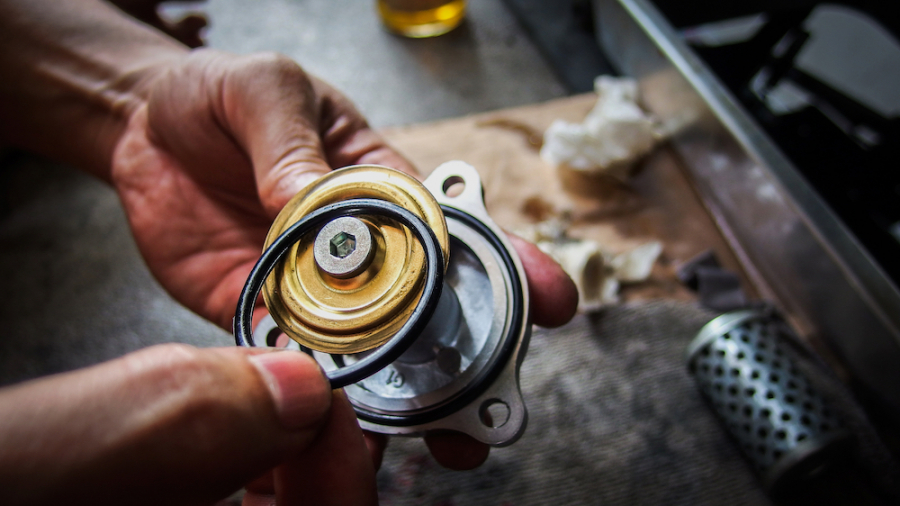
O-Rings are circular elastomer seals used to create a sealing interface between mating components. They are commonly used in equipment and systems for sealing fluids or gases, with the appropriate O-Ring depending on the application, material compatibility, dimensions and operating conditions.
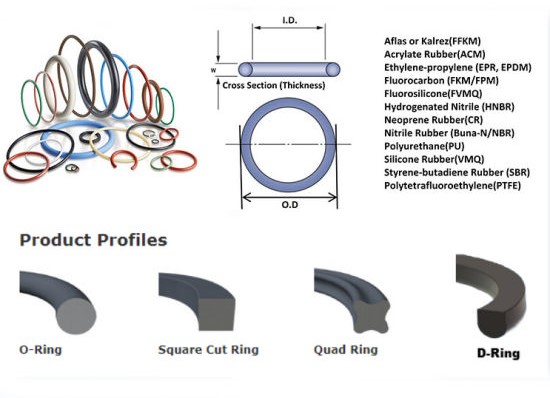
Sunseal supplies O-Rings in materials including NBR, FKM/Viton, Silicone, Aflas® and FFKM. Different materials have different properties, so material selection should consider factors such as the media being sealed, operating temperature, pressure and application environment.
O-Ring Dimensions
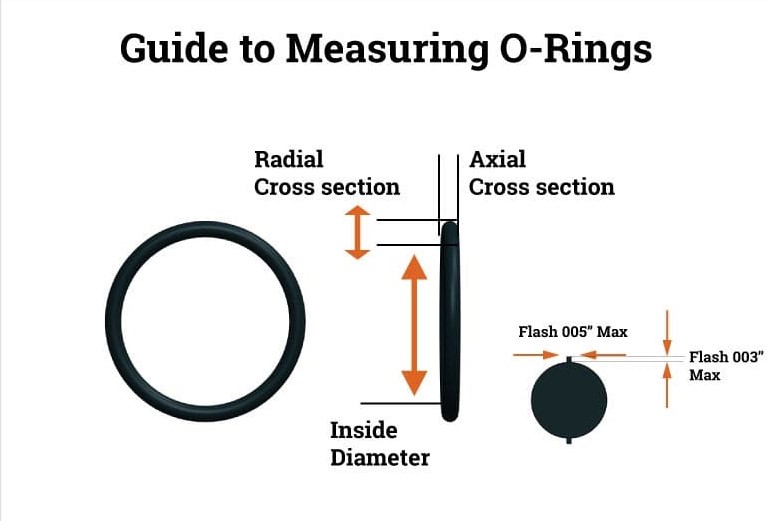
O-Ring sizing is based primarily on the inside diameter (ID) and cross-section (CS). The outside diameter (OD) can be calculated from these dimensions:
OD = ID + (CS × 2)
For example, an O-Ring may be specified as ID 20 mm × CS 2 mm. Providing the correct dimensions is important when replacing an existing O-Ring or selecting a new seal.
Sunseal supplies O-Rings according to recognised sizing standards, including AS 568B, DIN ISO 3601 and JIS, while also offering options for specific or non-standard requirements.
O-Ring Materials and Profiles
Material selection should be based on the operating environment rather than colour alone. Sunseal supplies O-Rings in various elastomer materials, including NBR, FKM/Viton, Silicone, Aflas® and FFKM.
In addition to standard O-Rings, Sunseal also supplies:
- O-Ring Cord for applications requiring continuous sealing material
- Viton tubing/hollow cord for specialised sealing requirements
- X-Rings, also known as quad rings, with a four-lobed profile
- Square Rings with a square cross-section for applications where a different sealing profile is required
For other industrial sealing requirements, Sunseal also supplies oil seals, pneumatic seals and gaskets for different applications.

V-Ring Malaysia
V-Rings are flexible rubber seals designed for shaft applications, particularly where protection against lubricant leakage and external contaminants is required. They are commonly used with rotating shafts and can provide a sealing barrier against substances such as dust, dirt and moisture.
Unlike an O-Ring, a V-Ring has a flexible sealing lip that works against an axial counterface. This makes the V-Ring suitable for applications involving rotating shafts where contamination exclusion and lubricant retention are important considerations.
When selecting a V-Ring, consider the shaft diameter, available installation space, operating speed, temperature and surrounding environment. Providing the shaft dimensions and equipment details can help identify a suitable V-Ring for the application.
For applications requiring other types of industrial sealing, Sunseal also supplies pneumatic seals and other sealing products.
Selecting the Right O-Ring or V-Ring
The correct seal depends on the equipment and operating conditions. When requesting an O-Ring or V-Ring, it is useful to provide:
- Existing seal dimensions or part number
- Shaft, bore or groove dimensions where applicable
- Type of equipment or application
- Fluid, gas or other media being sealed
- Operating temperature and pressure
- Shaft speed or type of movement
- Existing seal material, if known
- Manufacturer or equipment model information
For O-Rings, material compatibility is particularly important because exposure to unsuitable fluids, temperatures or operating conditions can affect seal performance. For V-Rings, shaft dimensions and the surrounding installation conditions should also be considered.
Providing accurate product and application information allows Sunseal to recommend a more suitable sealing option for the specific requirement.
Frequently Asked Questions (FAQs)
How do I choose the right O-Ring material?
Consider the fluid or gas being sealed, operating temperature, pressure and application environment. Sunseal supplies materials including NBR, FKM/Viton, Silicone, Aflas® and FFKM for different sealing requirements.
What information should I provide when ordering an O-Ring?
Provide the inside diameter, cross-section, existing part number or seal dimensions where available. Equipment details, operating conditions and the media being sealed can also help with material selection.
What is the difference between an O-Ring and a V-Ring?
O-Rings are circular seals commonly used between mating components, while V-Rings are flexible shaft seals designed primarily for rotary applications. The appropriate type depends on the equipment and sealing requirement.
Are O-Rings suitable for rotating applications?
O-Rings can be used in certain dynamic applications, but suitability depends on factors such as speed, pressure, lubrication, dimensions and seal design. For rotary shaft applications where contamination exclusion is required, a V-Ring may be more appropriate.
Does Sunseal supply non-standard O-Ring sizes?
Sunseal supplies O-Rings according to recognised sizing standards and can also cater to specific or non-standard requirements. Providing the required dimensions and application details can help determine a suitable option.
What other sealing products does Sunseal supply?
In addition to O-Rings and V-Rings, Sunseal supplies gaskets and other industrial sealing products for different equipment and application requirements.