


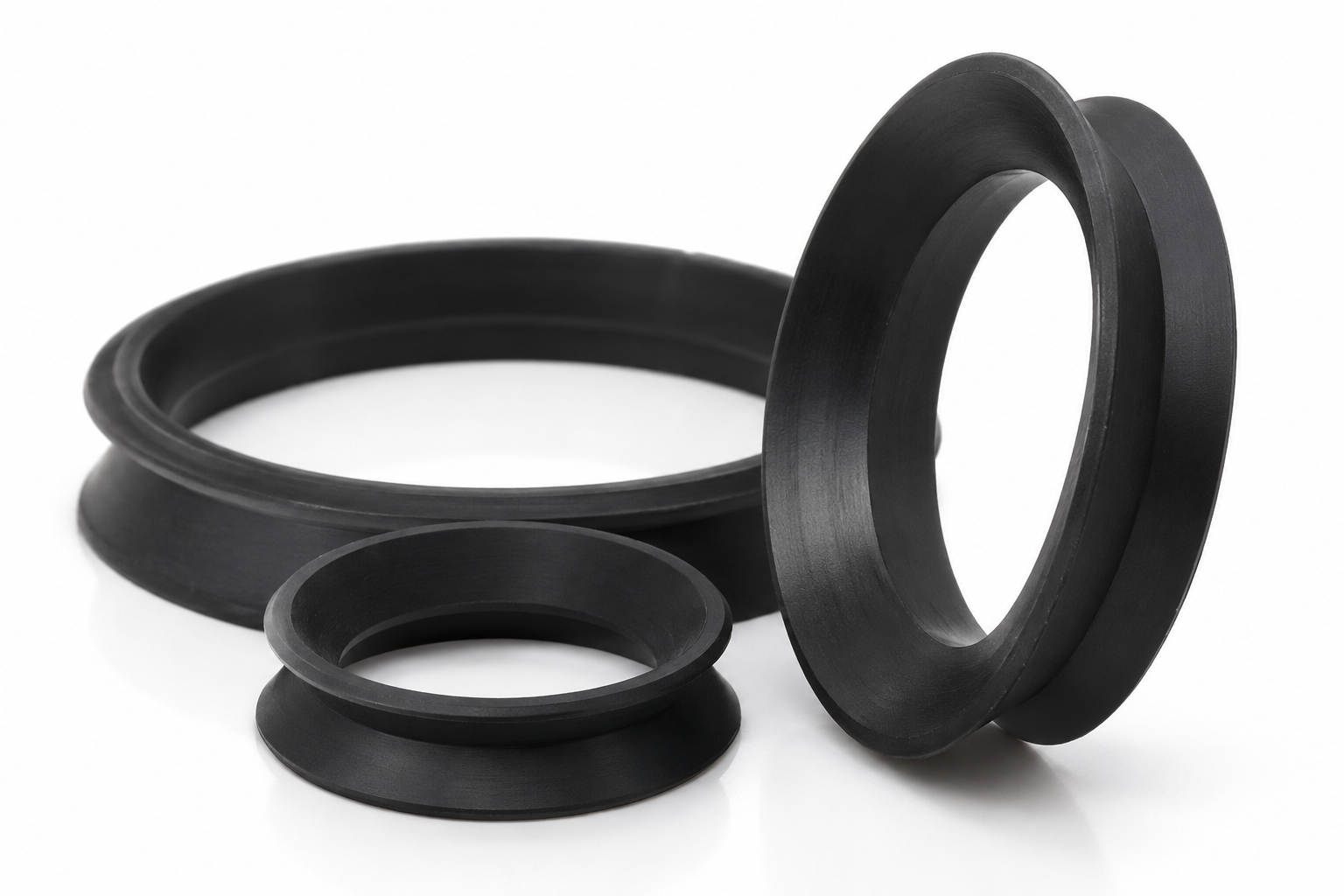

Description
V-Rings for Rotating Shaft Applications
Unlike an O-Ring fitted within a sealing groove, a typical V-Ring rotates with the shaft while its flexible lip runs against an axial sealing surface, also known as a counterface.
This arrangement is commonly used to protect rotating equipment from external contamination. Depending on the application, a V-Ring may be used as a primary contaminant-exclusion seal or as additional protection alongside another shaft seal.
V-Rings may be considered for equipment such as:
- Electric motors
- Pumps
- Gearboxes
- Bearing housings
- Other industrial rotating machinery
The suitability of a V-Ring depends on the equipment’s shaft arrangement, available installation space and operating environment.
Choosing the Right V-Ring
A suitable V-Ring must fit the shaft and maintain the intended contact with its counterface.
| Selection factor | What to check |
| Shaft diameter | Confirm the shaft size where the V-Ring will be installed |
| Counterface | Check the sealing surface condition, position and compatibility |
| Installation space | Confirm sufficient axial clearance for the sealing lip and body |
| Rotational speed | Check the equipment’s operating speed against the selected seal specification |
| Operating environment | Identify exposure to dust, water, lubricants or chemicals |
| Temperature | Confirm the operating temperature and appropriate elastomer material |
| Existing V-Ring profile | Provide the original profile or part number where available |
Different V-Ring designs may have different dimensional and installation requirements. The original equipment specification should be followed when available.
V-Ring Installation Considerations
Correct positioning is important because the V-Ring’s sealing lip must contact the intended counterface.
Before installation:
- Check that the shaft and sealing surface are clean and free from damaging burrs or sharp edges.
- Inspect the V-Ring for cracking, distortion or other visible damage.
- Position the seal according to its intended orientation and installation requirements.
- Confirm that the sealing lip contacts the counterface evenly.
- Check the required axial position and clearance before operating the equipment.
Avoid excessive stretching, twisting or forcing the ring over sharp components during installation.
For further guidance, refer to Sunseal’s V-Ring installation guide.
V-Rings and Other Shaft Seals
V-Rings and radial oil seals can serve different purposes within rotating equipment.
A V-Ring is commonly selected to help exclude external contamination at an axial sealing surface. A radial oil seal typically seals against the shaft surface and may be used to retain lubricant within the equipment.
In some applications, both seals can be used together. However, a V-Ring should not automatically be treated as a substitute for a pressure-rated oil seal.
Sunseal also supplies oil seals for other shaft-sealing requirements and O-Rings for applications requiring a different sealing arrangement.
Requesting V-Rings from Sunseal
If you are sourcing a replacement V-Ring, provide the existing part number or profile where available.
Where that information is missing, useful details include:
- Shaft diameter
- Equipment make and model
- Existing seal dimensions or photographs
- Available installation space
- Rotational speed
- Counterface condition and arrangement
- Operating temperature
- Exposure to water, dust, lubricant or chemicals
These details can help Sunseal assess the application and identify suitable product options.
Frequently Asked Questions (FAQs)
My machine already has an oil seal. Would adding a V-Ring be useful?
It may be useful when additional protection against dust, water or other external contaminants is needed. A V-Ring can sometimes work alongside an existing radial oil seal, but the shaft arrangement, clearance and counterface must accommodate it. Check the equipment design before adding another seal.
What should I send Sunseal if I cannot identify the existing V-Ring profile?
Provide clear photographs of the removed seal, its cross-section and the installation area. Include the shaft diameter, equipment model and any visible markings. Measurements of the available space and counterface position may also help determine which replacement profile should be investigated.
Why is my replacement V-Ring wearing unevenly around the sealing lip?
Uneven wear may be associated with incorrect axial positioning, counterface damage, misalignment or an unsuitable seal configuration. Inspect the contact surface and confirm the installation dimensions against the selected V-Ring specification. Replacing the ring without correcting the underlying condition may result in repeated wear.
Can I use a V-Ring on a high-speed rotating shaft?
Possibly, but the permitted rotational speed depends on the selected V-Ring design, size and installation arrangement. Some applications require additional measures to retain the seal’s position. Provide Sunseal with the shaft diameter, operating speed and equipment details so the relevant product specifications can be checked.
What should I consider when requesting a V-Ring for equipment exposed to water or dust?
Identify whether exposure involves occasional splashing, regular washdown, fine dust or abrasive contamination. Also provide the operating temperature, shaft speed and existing seal arrangement. These details help determine whether a V-Ring configuration and material are suitable for the operating environment.